
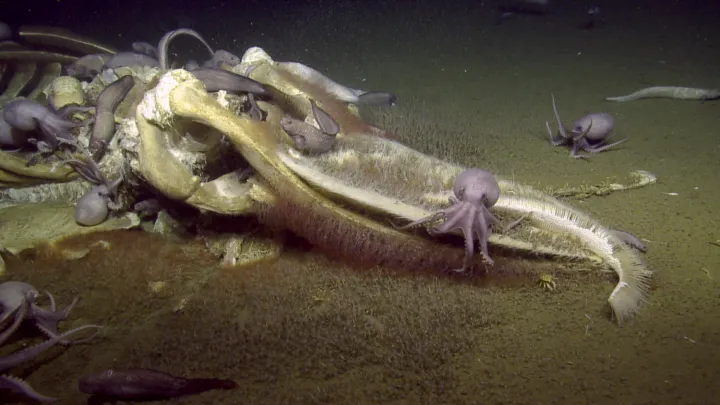
The deepest parts of the ocean are among the most extreme environments on Earth. Sunlight disappears completely, temperatures can be near freezing, food is scarce, and the pressure is enormous.
Yet life exists even in these seemingly impossible conditions.
From strange snailfish and giant amphipods to mysterious jellyfish and microscopic organisms, animals have developed incredible adaptations that allow them to survive thousands of meters below the surface.
Here are some of the deepest-dwelling animals in the ocean and the fascinating secrets of life in the deep sea.

1. Mariana Snailfish
The Mariana snailfish is one of the deepest-living fish ever recorded.
It has been observed at depths of roughly 8,000 meters (26,000 feet) in the Mariana Trench.
At these depths, pressure is enormous, yet this small, delicate-looking fish can survive conditions that would be fatal to most animals.

2. Hadal Snailfish
Snailfish are particularly successful inhabitants of the deepest ocean trenches.
Several species have adapted to hadal zones, the deepest parts of the ocean found below about 6,000 meters.
Their soft bodies and specialized biology help them withstand tremendous pressure.
3. Giant Amphipods
Amphipods are small crustaceans related to shrimp.
In the deep ocean, however, some species can become surprisingly large.
Giant amphipods have been discovered in deep trenches and are often scavengers, feeding on organic material that reaches the seafloor.
4. Deep-Sea Isopods
Deep-sea isopods are relatives of familiar pill bugs and woodlice.
Some species have large, armored bodies and can survive in extremely cold, high-pressure environments.
They often scavenge on dead animals and other organic material.
5. Sea Cucumbers
Sea cucumbers are among the most common animals on many deep-sea floors.
They crawl slowly across sediment, consuming organic particles and helping recycle nutrients.
Their simple appearance hides an important ecological role.

6. Deep-Sea Jellyfish
Jellyfish can live at extraordinary depths.
Some deep-sea species have unusual shapes and can produce light through bioluminescence.
Because sunlight cannot reach these depths, producing light can be useful for communication, attracting prey, or confusing predators.
7. Giant Siphonophores
Siphonophores are unusual colonial animals made up of many specialized individuals working together.
Some deep-sea siphonophores can grow to enormous lengths, potentially reaching tens of meters.
Despite their length, they can be incredibly delicate and difficult to observe in their natural environment.